
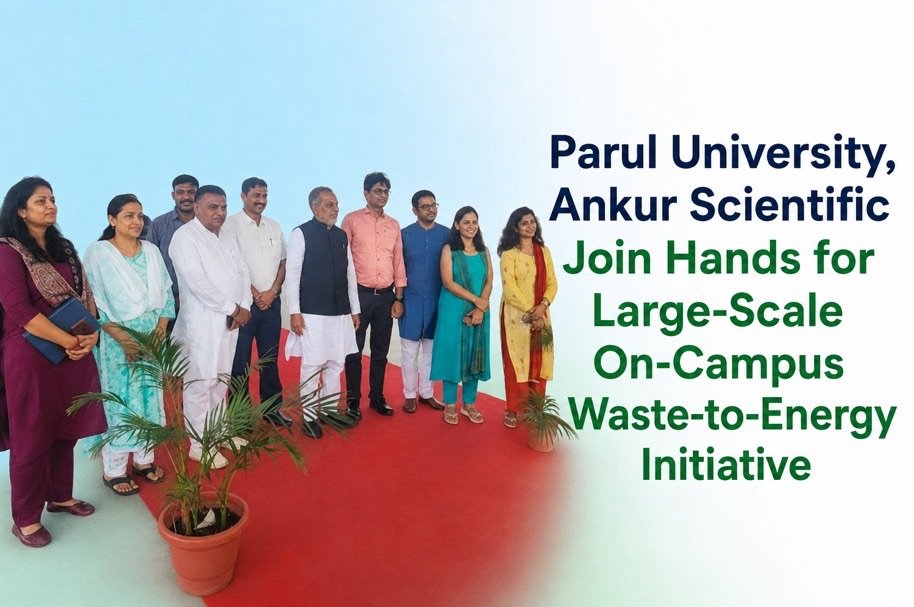
Parul University Partners with Ankur Scientific to Transform Campus Waste into Clean Energy and Biochar

Parul University has partnered with Ankur Scientific to implement an integrated on-campus waste-to-energy solution aimed at converting suitable campus waste into useful energy and valuable carbon resources.
With a campus community of more than 50,000 students and faculty members, the initiative demonstrates how large educational institutions and self-contained developments can adopt decentralised waste management systems and process waste closer to where it is generated.
The project uses advanced thermochemical conversion technology to process suitable waste streams, including paper, cardboard, plastic packaging, textiles, leather, rubber, wood, dry garden waste and dry municipal solid waste. The conversion process produces producer gas, which can be used for fuel and thermal energy applications, along with carbon-rich biochar that can support applications such as soil improvement and carbon sequestration.
As part of the wider waste management strategy, recyclable materials will be sent for recycling, organic waste will be composted or converted into biogas, and remaining waste streams will be managed through authorised disposal channels.
The partnership highlights the growing role of waste-to-energy and circular economy solutions in reducing landfill dependence, transportation requirements and associated emissions while recovering useful resources from waste. It could also serve as a replicable model for universities, industrial townships, corporate campuses and other large developments across India.
Key Highlights:
- Parul University partners with Ankur Scientific for an integrated waste-to-energy project.
- Suitable campus waste will be converted into energy and carbon-rich biochar.
- Thermochemical technology can process multiple suitable dry waste streams.
- Producer gas can support fuel and thermal energy applications.
- The initiative promotes decentralised waste management and circular economy practices.
- The model could be replicated across large campuses and townships.