
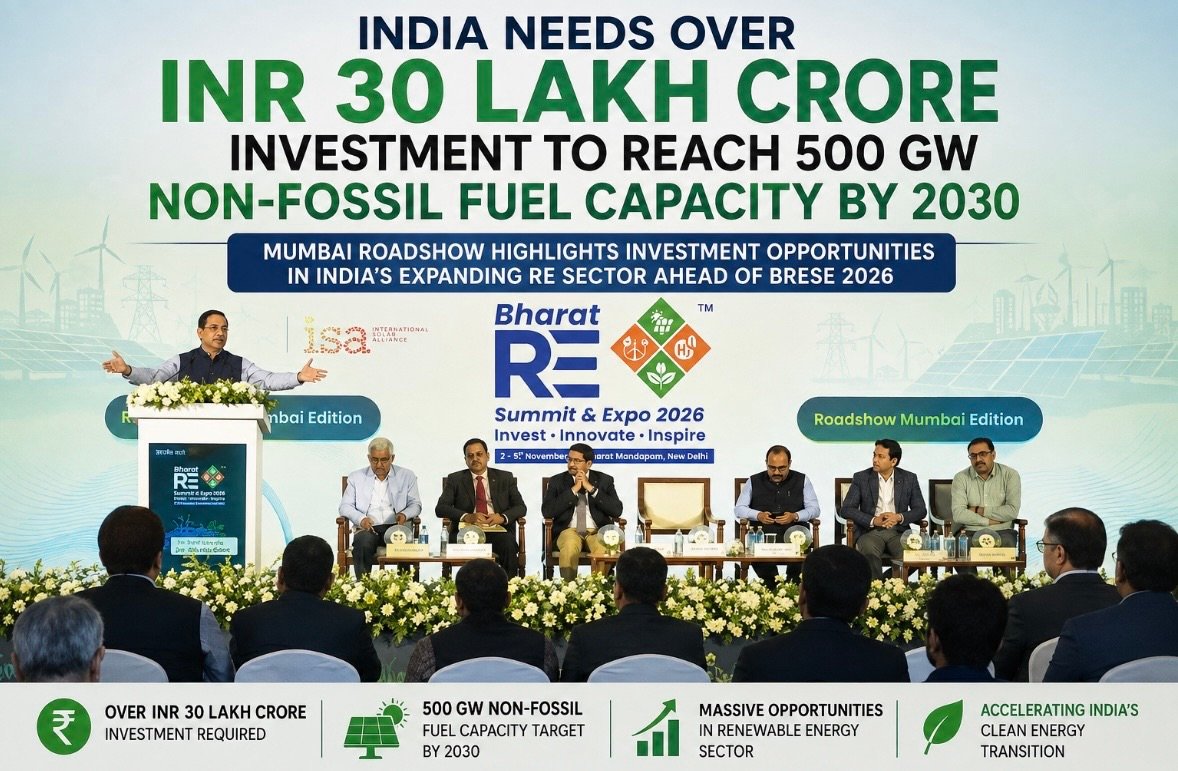

India will require more than ₹30 lakh crore of investment over the next five years to achieve its target of 500 GW of non-fossil fuel capacity by 2030, Union Minister for New and Renewable Energy Pralhad Joshi said during the Mumbai roadshow for the Bharat Renewable Energy Summit & Expo (BRESE) 2026.
The minister highlighted the scale of the investment opportunity for financial institutions, capital markets, insurance funds, infrastructure investors and private capital as India accelerates its clean-energy transition.
India’s installed non-fossil fuel capacity has crossed the 300 GW mark, reaching around 302–303 GW. According to Joshi, the country’s non-fossil capacity has increased from 80.3 GW to around 300.5 GW over the past 12 years, representing a growth of nearly 275%.
Solar power has emerged as a major driver of this expansion. Solar capacity has grown from just 2.8 GW to around 165 GW, representing nearly 58 times growth. Wind capacity has also increased from approximately 21 GW to 58 GW during the same period.
India added more than 17 GW of renewable energy capacity during the first four months of FY2026-27, including 14.33 GW of solar and more than 2 GW of wind capacity. The continued pace of deployment will be critical as the country works towards its 2030 target.
Joshi also underlined Mumbai’s role as a major clean-energy investment hub because of its concentration of financial institutions and investors. He encouraged Maharashtra to showcase its renewable-energy initiatives and explore international partnerships, particularly in areas such as solarisation of agriculture.
Maharashtra has separately set a target of reaching 65 GW of renewable energy capacity by 2030. The state is also expanding rooftop solar and solar pump installations under central and state programmes.
The investment requirement highlights the scale of financing needed across solar, wind, energy storage, transmission and other clean-energy infrastructure to support India’s transition towards a low-carbon power system.