
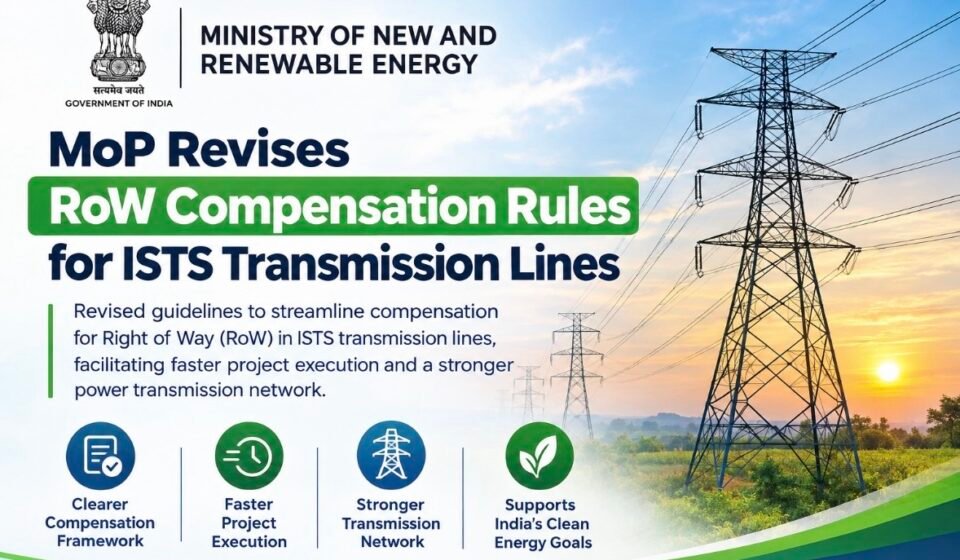
India’s Power Ministry Revises RoW Compensation Rules for Inter-State Transmission Lines

The Ministry of Power (MoP) has revised the Right of Way (RoW) compensation guidelines for Inter-State Transmission System (ISTS) lines, introducing a mechanism to determine land compensation based on prevailing market rates when they exceed applicable circle rates.
Under the revised guidelines, a Market Rate Committee (MRC), headed by the District Magistrate, District Collector or Deputy Commissioner, will determine land values in cases where landowners dispute compensation based on lower government-notified rates.
The mechanism will use valuations from three independent valuers empanelled by the Insolvency and Bankruptcy Board of India (IBBI). The valuers must submit their reports within 21 days of selection, with the final market rate calculated using the normalised valuations.
The guidelines specify compensation at 200% of the market value for tower base areas. For the Right of Way corridor, compensation will be 30% of the market value in rural areas, 45% in municipalities and other notified urban planning areas, and 60% in municipal corporations and notified metropolitan areas.
The guidelines apply to relevant ISTS transmission lines of 66 kV and above. States and Union Territories may adopt the framework or introduce modified policies, while the central guidelines will apply where a state has not specified a mechanism for determining land value.
The Ministry has also encouraged the use of space-optimising technologies, including compact towers, steel poles, underground cables and multi-circuit transmission systems, to address Right of Way constraints. Additional RoW compensation paid by transmission service providers may also qualify for a pass-through under the Change in Law provisions of the Central Electricity Regulatory Commission (CERC).
The revised framework aims to address landowner disputes, improve compensation transparency and support faster execution of transmission infrastructure critical to India’s expanding power and renewable energy sectors.
Source: Energetica India