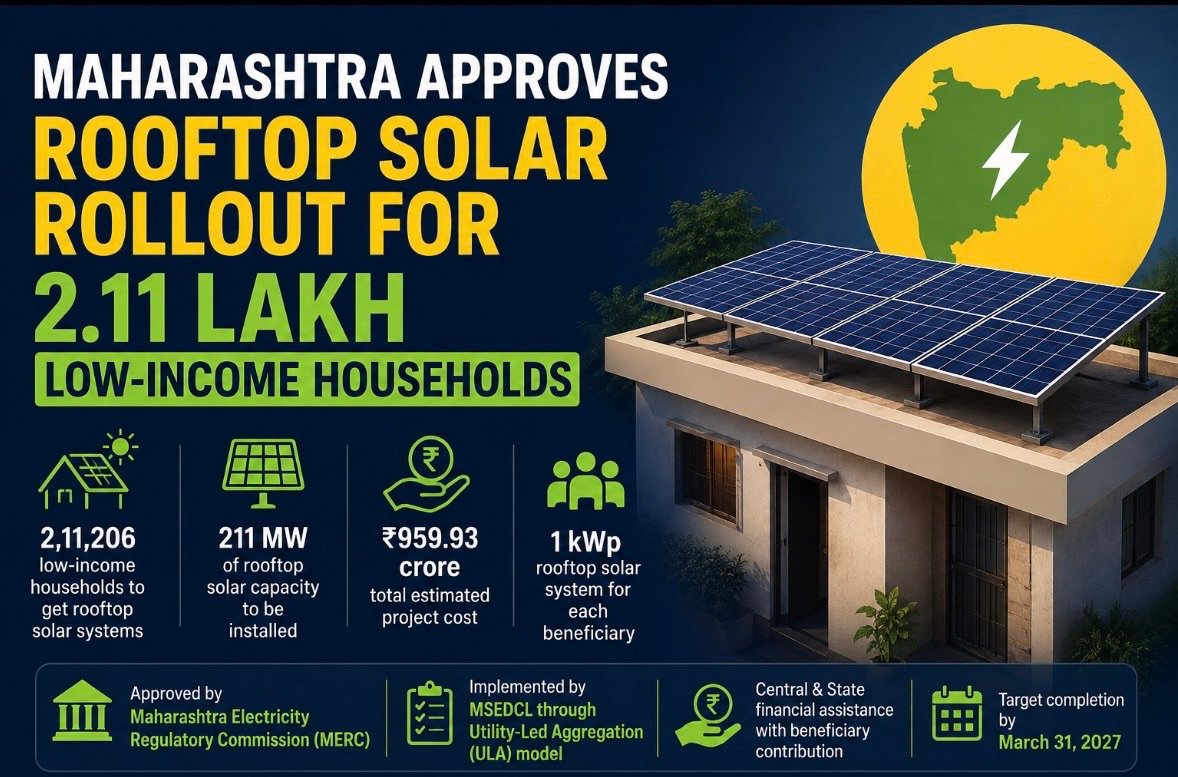

The Maharashtra Electricity Regulatory Commission (MERC) has approved the rollout of individual rooftop solar systems for 2,11,206 low-income households across Maharashtra under the PM Surya Ghar: Muft Bijli Yojana and the state’s Swayampurna Maharashtra Aawasiya Rooftop Solar (SMART) Scheme.
The programme, to be implemented by Maharashtra State Electricity Distribution Company Limited (MSEDCL)through the Utility-Led Aggregation (ULA) model, is expected to support approximately 211 MW of rooftop solar capacity.
Under the approved plan, each beneficiary household will receive an individual 1 kWp rooftop solar system. The total estimated project cost is ₹959.93 crore, with around 60% expected to be supported through Central Financial Assistance and 30–35% through State Financial Assistance. Beneficiaries will contribute the remaining 5–10%, within the limits prescribed under the ULA guidelines.
The beneficiary base includes 1,27,362 BPL households and 83,844 SC/ST households under the EWS category. Contributions have been capped at ₹2,500 for BPL households and ₹5,000 for SC/ST EWS households, helping make rooftop solar more accessible to economically weaker consumers.
MSEDCL will implement the installations through 43 vendors selected through a tender process at a discovered rate of ₹45,450 per kW. The systems will include data monitoring through M2M SIM or Wi-Fi-enabled data loggers, while vendors will provide five years of comprehensive operation and maintenance services.
The initiative aligns Maharashtra’s SMART scheme with the national PM Surya Ghar programme. The state scheme aims to solarise 5 lakh BPL and EWS households with low monthly electricity consumption and provide eligible consumers with access to free electricity through rooftop solar generation.
The approved 2,11,206-household programme is targeted for completion by March 31, 2027, ensuring compliance with the timeline for Central Financial Assistance.
The approval marks a significant step toward expanding distributed solar generation in Maharashtra while improving clean-energy access and reducing electricity costs for low-income households.