
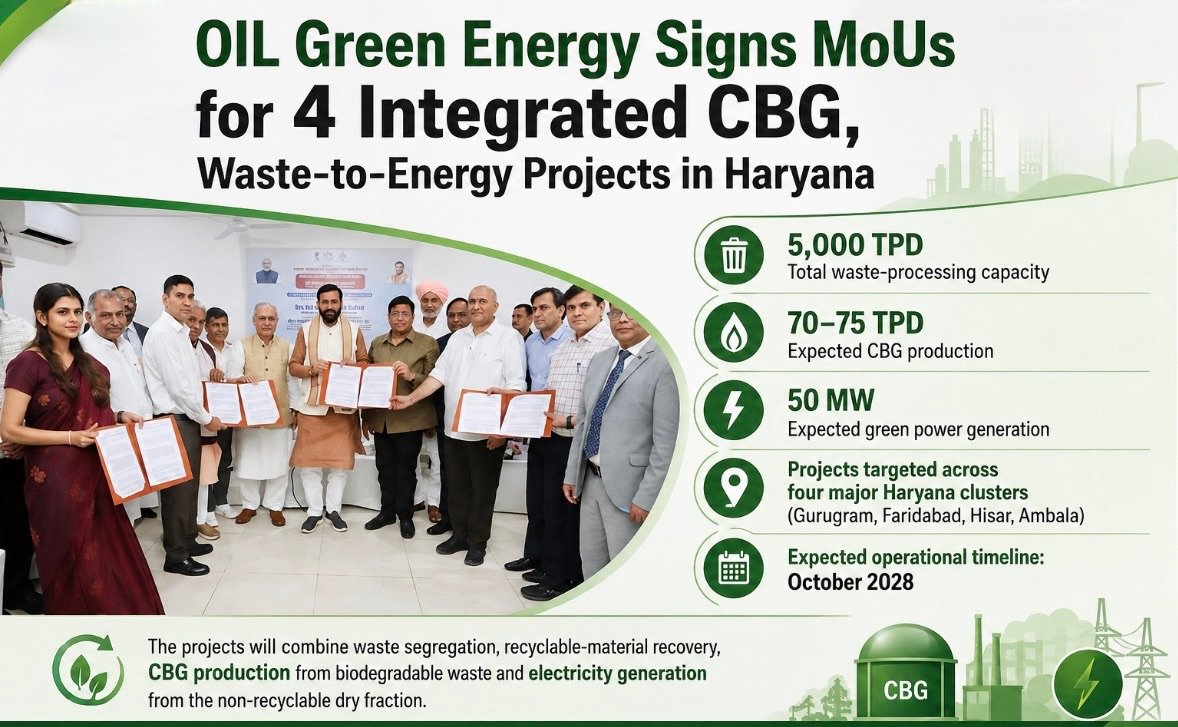

OIL Green Energy Limited (OGEL), a wholly owned subsidiary of Oil India Limited, has signed Memoranda of Understanding (MoUs) with four municipalities in Haryana to develop integrated Compressed Biogas (CBG) and Waste-to-Energy projects. The proposed facilities across Gurugram, Faridabad, Hisar and Ambala will collectively process 5,000 tonnes of municipal solid waste per day and are expected to produce 70–75 tonnes per day of CBG along with 50 MW of green power.
The MoUs were signed on August 30, 2026, in the presence of Haryana Chief Minister Nayab Singh Saini, senior state government representatives and officials from Oil India and OGEL. The projects are planned across four urban clusters, with the Gurugram facility accounting for 2,000 tonnes per day (TPD), Faridabad 1,600 TPD, Ambala 900 TPD and Hisar 500 TPD of waste-processing capacity.
The proposed facilities will follow an integrated waste-processing model rather than relying solely on conventional waste-to-energy conversion. Municipal solid waste will first undergo scientific processing and segregation to recover recyclable materials. The wet and biodegradable fraction will be directed towards CBG production, while the remaining non-recyclable dry fraction will be used for electricity generation through Waste-to-Energy facilities. This approach is designed to improve resource recovery while reducing the volume of waste requiring landfill disposal.
The four projects are expected to generate a combined minimum of 50 MW of electricity, with the individual facilities planned to contribute at least 5 MW in Hisar, 9 MW in Ambala, 16 MW in Faridabad and 20 MW in Gurugram. Reports indicate that the facilities are targeted for commissioning by October 2028.
The projects are also aligned with the Government of India’s GOBARdhan–National Circular Bioenergy Scheme 2026, which promotes scientific management of organic waste and its conversion into CBG and other clean-energy products. The initiative supports the broader waste-to-wealth and circular-economy approach by combining waste management, renewable fuel production and green power generation.
For Oil India, the Haryana agreements strengthen the company’s strategy of expanding beyond conventional oil and gas into low-carbon energy businesses. OIL is already pursuing a nationwide CBG programme involving 25 planned plants using municipal solid waste, agricultural waste and other organic feedstocks. The company has also reported an installed renewable-energy portfolio of 188.1 MW comprising wind and solar projects.
The Haryana projects could therefore become an important addition to India’s waste-to-energy and bioenergy ecosystem. By converting municipal waste into CBG and electricity, the initiative links urban waste management with clean-energy generation and demonstrates how integrated waste-to-clean-energy projects can contribute to India’s wider energy transition.