
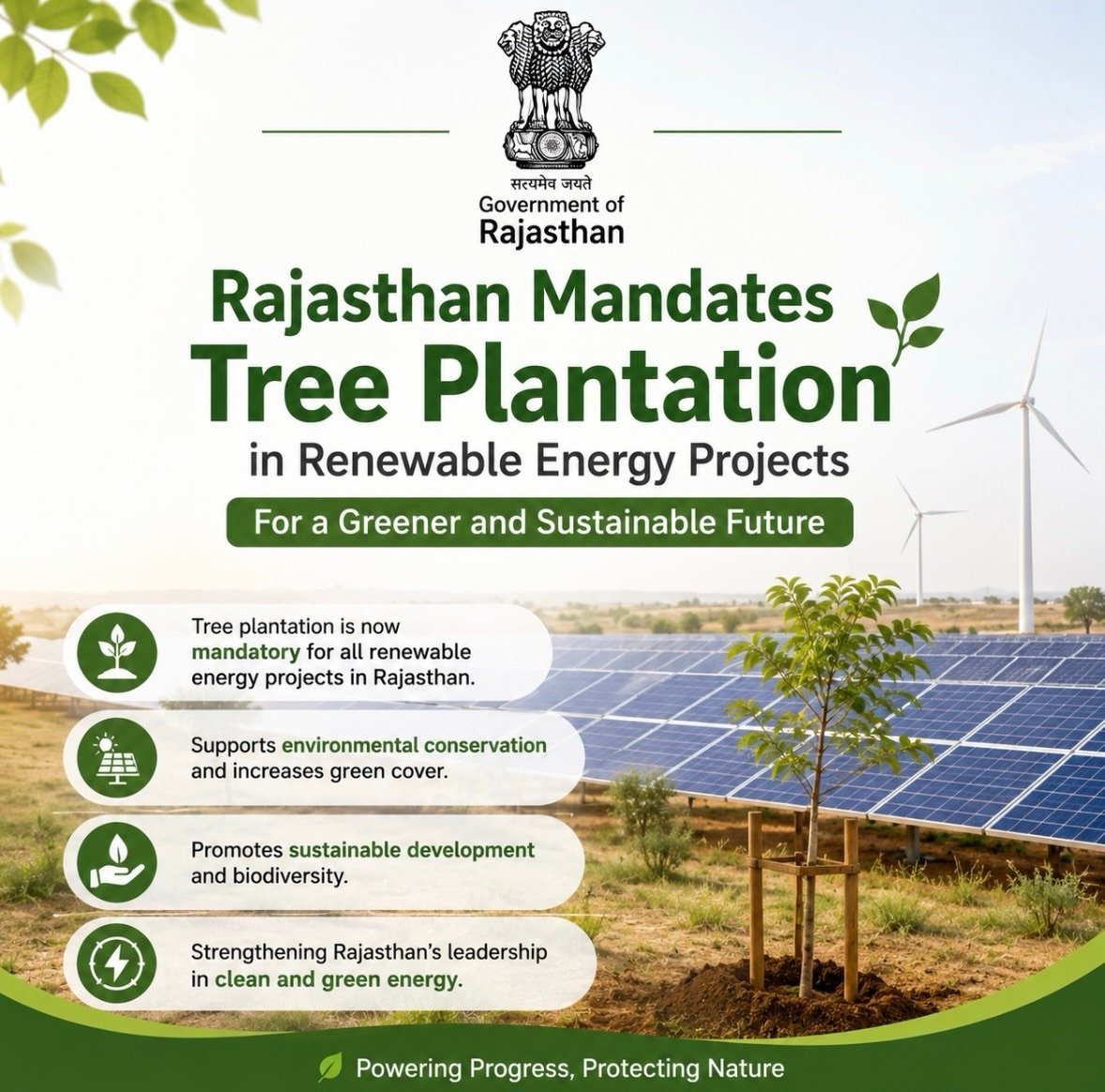
Rajasthan Mandates Tree Plantation for Renewable Energy Projects to Promote Sustainable Development

The Rajasthan government has introduced a new environmental requirement for renewable energy projects, making tree plantation a mandatory component of project development. The move aims to balance the state’s rapid expansion of solar and wind power with environmental conservation.
Under the new framework, renewable energy developers will be required to undertake plantation activities as part of their project implementation. The initiative is intended to increase green cover, support biodiversity and reduce the environmental impact associated with large-scale renewable energy infrastructure.
Rajasthan has emerged as one of India’s leading renewable energy destinations, particularly for utility-scale solar projects. With large renewable parks and extensive project pipelines, the state is witnessing rapid development of clean-energy infrastructure across its districts.
The plantation mandate adds a stronger environmental dimension to this expansion. Developers will need to consider green-cover creation alongside land use, project construction and energy generation.
The move also reflects a broader shift in India’s renewable energy sector, where sustainability is increasingly being evaluated beyond installed capacity. Large-scale solar and wind projects are now expected to consider land management, biodiversity, vegetation and local environmental impacts as part of responsible project development.
For renewable energy developers, the new requirement could encourage more integrated approaches to project planning, including plantation programmes, green belts and ecological restoration around project sites.
Key Highlights
- 🌱 Tree plantation mandated for renewable energy projects
- ☀️ Applies to renewable energy project development in Rajasthan
- 🌳 Focus on increasing green cover and environmental conservation
- ⚡ Rajasthan continues to expand its solar and wind capacity
- 🇮🇳 Supports a more sustainable approach to India’s clean-energy transition
The initiative underlines Rajasthan’s effort to combine its renewable energy ambitions with environmental responsibility, ensuring that the growth of clean power is accompanied by measures to strengthen the state’s ecological footprint.